The growing challenge of credential management for AI agents
We are entering the era of agentic AI, where AI agents are no longer experimental tools or isolated assistants. They are becoming core components of modern software systems, executing tasks, making decisions, and interacting with external services on behalf of users and organizations. As adoption accelerates, enterprises are rapidly embedding AI agents into business-critical workflows.
Under the hood, most of these agents rely on GenAI platform APIs, with OpenAI being the most widely used provider today. To access these APIs, AI agents authenticate using API keys. This same pattern applies to other major providers such as Mistral and Anthropic Claude, and is likely to remain common across the broader GenAI ecosystem.
The core problem: long-lived static API keys
OpenAI API keys are:
- Long-lived
- Static
- Highly sensitive
This model was acceptable when only a small number of centrally managed applications accessed AI APIs. It breaks down in an environment where large numbers of AI agents are deployed dynamically across clusters, regions, and teams.
Long-lived static API keys introduce several systemic issues:
- Security risk: a leaked key grants broad access until manually revoked
- Operational burden: rotation, revocation, and distribution must be managed continuously
- Compliance challenges: static credentials conflict with zero-trust, least-privilege, and modern audit requirements
In practice, these keys often end up embedded in configuration files, CI pipelines, container images, or environment variables, significantly increasing the blast radius of any compromise.
Vault and OpenBao help — but not enough
HashiCorp Vault and OpenBao address part of this problem by supporting dynamic OpenAI API keys through a secrets engine. With this approach:
- API keys are generated on demand
- Keys are short-lived
- Vault/OpenBao automatically revokes keys upon expiration
This is a major improvement over static secrets. Credentials are no longer perpetual, and the window of exposure is dramatically reduced.
However, this does not fully solve the problem.
Even temporary OpenAI API keys must still be:
- Securely delivered to the AI agent
- Protected from other workloads running on the same infrastructure
- Refreshed seamlessly as they expire
To achieve this, developers typically need to:
- Integrate Vault/OpenBao SDKs into every AI agent
- Provision credentials that allow agents to authenticate to Vault/OpenBao
- Implement renewal, retry, and error-handling logic
As the number of agents grows, this approach becomes increasingly complex and fragile.
According to Gartner: Gartner predicts that 40% of enterprise applications will feature task-specific AI agents by 2026, up from less than 5% in 2025.
At this scale, secret distribution and credential management are no longer application-level concerns — they become platform-level security challenges.
How Riptides solves this
Riptides addresses this challenge by starting from a different premise: identity must be the root of trust.
Identity first, secrets second
With Riptides:
- Every workload runs with a verifiable, SPIFFE-based workload identity
- Identity is enforced at runtime, not inferred from configuration
- Access decisions are based on who the workload is, not what secrets it happens to possess
Exchanging identity for OpenAI API keys
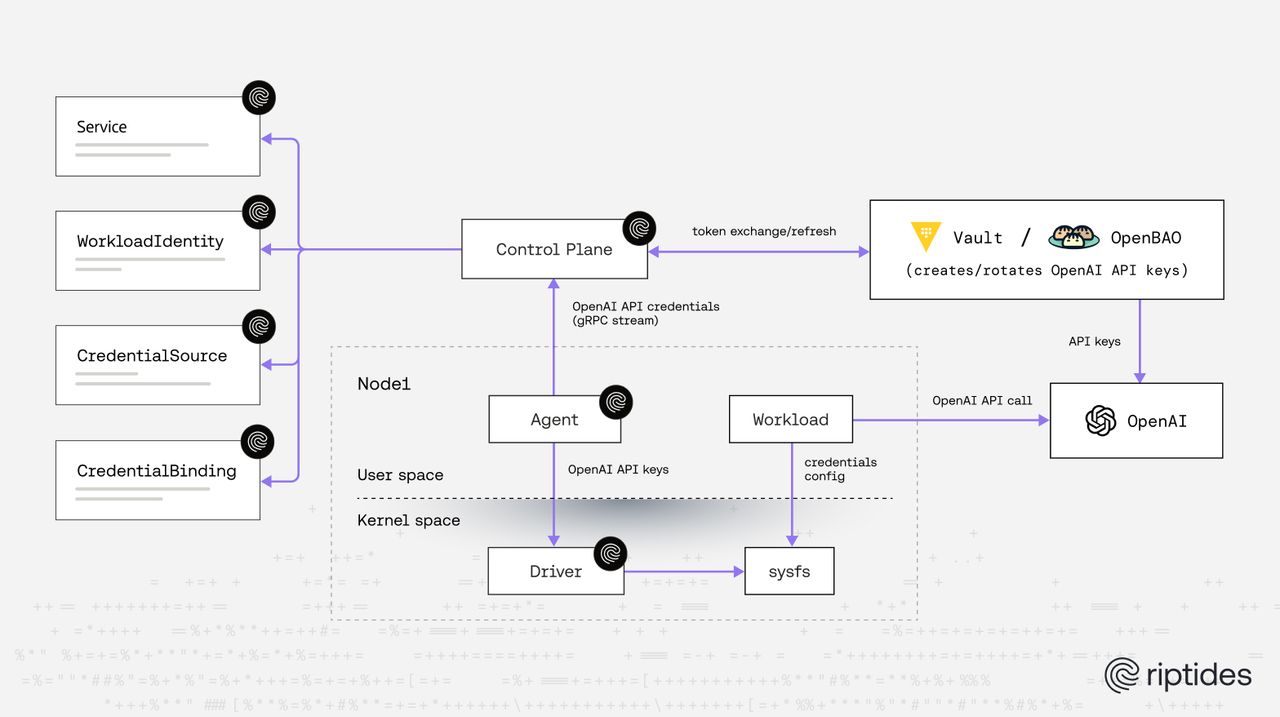
Riptides relies on tokenex to access Vault and OpenBao secrets through their native JWT authentication mechanisms, exchanging workload identity tokens for secrets without issuing or storing any Vault/OpenBao tokens.
Using tokenex, Riptides:
- Issues ID tokens (JWTs) to verified workloads
- Encodes the workload’s SPIFFE identity into those tokens
- Exchanges the ID token for a short-lived OpenAI API key via Vault or OpenBao
This ensures that:
- Only authenticated and authorized workloads can obtain OpenAI credentials
- OpenAI API keys are temporary by default
- No static OpenAI keys are embedded in application code, configuration, or images
Secure delivery enforced by the kernel
Riptides retrieves short-lived OpenAI API keys from Vault/OpenBao on demand and places them into a dedicated sysfs file provided by the Riptides Linux kernel module, ensuring that read access is enforced at the kernel level.
Key properties of this approach:
- Access to the sysfs file is enforced in the Linux kernel, not by application logic
- Only the workload bound to the expected SPIFFE identity is authorized to read the file’s contents
- Other processes on the same node, even if co-located, are prevented from accessing the secret
From the AI agent’s perspective, consumption is trivial:
- The API key is read via a simple file operation
- No Vault/OpenBao SDK is required
- No custom secret refresh logic is needed
This makes secret consumption as simple as a file read, while ensuring that access control is stronger than environment variables or in-process memory, and cannot be bypassed by misconfiguration or code changes.
What this enables
By combining verifiable workload identity, short-lived credentials, and kernel-level enforcement, Riptides provides:
- Just-in-time issuance and delivery of short-lived OpenAI API keys, reducing credential exposure windows
- Zero long-lived secrets on the host: neither developers nor operators ever provision, store, or rotate API keys on the infrastructure where AI agents run
- Strong, kernel-enforced isolation between co-located workloads, limiting blast radius and preventing lateral access to credentials
- Clear separation of identity, access policy, and application logic, enabling consistent enforcement and auditable controls
Together, these properties align with least privilege, zero trust, and defense-in-depth principles, while simplifying compliance with security frameworks, and internal audit requirements.
Setting this up with Riptides
This section walks through how to configure Vault/OpenBao and Riptides so that AI agents can securely obtain short‑lived OpenAI API keys without embedding Vault clients, handling Vault tokens, or managing secrets directly in application code.
The configuration is presented step by step, with each snippet accompanied by an explanation of what it does, why it is needed, and how it fits into the overall flow.
Prerequisites
This guide assumes:
- Vault or OpenBao is already running
- JWT authentication is configured in Vault/OpenBao to trust the Riptides Control Plane as an OIDC issuer
- The OpenAI secrets engine plugin is installed
We do not cover JWT auth configuration in detail here. A complete example can be found in this post
For instructions on installing the OpenAI secrets engine plugin, see:
https://github.com/gitrgoliveira/vault-plugin-secrets-openai
Note
In all examples below, if you are using HashiCorp Vault instead of OpenBao, replace thebaoCLI withvault.
Enable the OpenAI secrets engine
bao secrets enable openaiThis command enables the OpenAI secrets engine at the openai/ path. Once enabled, Vault/OpenBao can dynamically generate OpenAI API keys instead of relying on static, long‑lived credentials.
Configure the OpenAI secrets engine
bao write openai/config \
  admin_api_key="$OPENAI_ADMIN_KEY" \
  admin_api_key_id="$OPENAI_ADMIN_KEY_ID" \
  organization_id="$OPENAI_ORG_ID"
Here you configure the secrets engine with an administrative OpenAI API key. This key is used only by Vault/OpenBao to create and revoke project‑scoped, short‑lived API keys on behalf of workloads.
This administrative key never leaves Vault/OpenBao and is not exposed to AI agents.
Create a role for generating OpenAI API keys
bao write openai/roles/my-role \
  project_id="$OPENAI_PROJ_ID" \
  service_account_name_template="vault-{{.RoleName}}-{{.RandomSuffix}}" \
  ttl=15m \
  max_ttl=1h
This role defines how Vault/OpenBao generates OpenAI API keys:
- Which OpenAI project the keys belong to
- How the backing OpenAI service account is named
- The default lifetime (
ttl) and maximum lifetime (max_ttl) of issued keys
Every API key generated through this role is short‑lived by design, limiting blast radius and exposure.
Create a policy allowing access to generated API keys
bao policy write read-openai-apikeys -<<EOF
path "openai/creds/my-role" {
  capabilities = ["read"]
}
EOF
This policy allows a client to read credentials generated by the my-role OpenAI role. It does not grant administrative privileges or access to other secrets.
In the next steps, this policy will be bound to a specific workload identity.
Configure JWT authentication for the AI agent identity
bao write auth/jwt/role/openai-apikeys \
    user_claim="sub" \
    bound_audiences="vault" \
    bound_subject="<AI_AGENT_WORKLOAD_SPIFFE_ID>" \
    token_policies="read-openai-apikeys" \
    token_type="service" \
    token_num_uses=2 \
    role_type="jwt"
This configuration tells Vault/OpenBao which identity is allowed to authenticate using JWTs:
- Authentication is bound to a specific SPIFFE workload identity (
bound_subject) - The JWT must be issued for the expected audience (
vault) - The resulting Vault token is short‑lived and limited to reading OpenAI API keys
No Vault token is stored or managed by the AI agent. Authentication is entirely JWT‑based and secretless.
Define the external OpenAI service in Riptides
apiVersion: core.riptides.io/v1alpha1
kind: Service
metadata:
  name: openai-api
  namespace: riptides-system
spec:
  addresses:
    - address: api.openai.com
      port: 443
  labels:
    app: openai-api
  external: true
This Riptides Service object declares OpenAI as an external dependency. It allows Riptides to apply identity‑aware egress policies when workloads communicate with the OpenAI API.
Configure Vault as a credential source
apiVersion: core.riptides.io/v1alpha1
kind: CredentialSource
metadata:
  name: vault-openai-apikeys
  namespace: riptides-system
spec:
  vault:
    address: http://localhost:8200
    jwtAuthMethodPath: jwt
    role: <JWT-AUTH-ROLE>
    path: openai/creds/my-role
    audience: ["vault"]
This CredentialSource tells Riptides:
- Which Vault/OpenBao instance to contact
- Which JWT auth role to use
- Which secret path to read
Riptides will exchange a workload identity JWT for a short‑lived OpenAI API key, without requiring Vault tokens or SDKs in the workload.
Define the workload identity for the AI agent
apiVersion: core.riptides.io/v1alpha1
kind: WorkloadIdentity
metadata:
  name: ai-agent
  namespace: riptides-system
spec:
  scope:
    agent:
      id: <AGENT_WORKLOAD_ID>
  workloadID: ai-agent
  selectors:
    - process:name: [<AI-AGENT-PROCESS-NAME>]
This object binds a SPIFFE-based workload identity to a specific process. Only the matching process is treated as the AI agent and is allowed to:
- Authenticate to Vault/OpenBao
- Receive OpenAI API keys
- Use those credentials when calling the OpenAI API
Bind the credential source to the workload
apiVersion: core.riptides.io/v1alpha1
kind: CredentialBinding
metadata:
  name: vault-openai-apikeys-binding
  namespace: riptides-system
spec:
  workloadID: ai-agent
  credentialSource: vault-openai-apikeys
  propagation:
    sysfs: {}
This CredentialBinding connects the AI agent identity with the Vault credential source and specifies how the credential is delivered.
By selecting sysfs, Riptides exposes the secret through a our Linux kernel module managed file.
Discover the sysfs file path
kubectl get credentialbindings.core.riptides.io -n riptides-system vault-openai-apikeys-binding -o yamlThis command shows the resolved credential binding, including the exact sysfs file path where the OpenAI API key is exposed.
Example output
status:
  state: OK
  sysfs:
    files:
    - path: /sys/module/riptides/credentials/2e08019a-a435-55e3-9ba7-f01c09b9fc2b/crb-vault-openai-apikeys-binding/vault.json
      type: CREDENTIAL
The file path shown above is created and managed by the Riptides Linux kernel module. Only the authorized workload can read its contents.
Contents of the sysfs credential file
{
  "api_key": "sk-svcacct-V8rgR1rZ-MVmeVUR-....",
  "api_key_id": "key_1Nj...",
  "service_account": "vault-my-role-...",
  "service_account_id": "user-gLNLYNq....."
}
This file contains the short‑lived OpenAI API key and associated metadata. The key exists only for its configured TTL and is revoked automatically by Vault/OpenBao.
Validate the API key
curl https://api.openai.com/v1/models \
  -H "Authorization: Bearer <api_key from vault.json>" \
  -H "OpenAI-Organization: <ORGANIZATION ID>" \
  -H "OpenAI-Project: <PROJECT ID>"
Output:
{
  "object": "list",
  "data": [
    {
      "id": "gpt-4-0613",
      "object": "model",
      "created": 1686588896,
      "owned_by": "openai"
    },
    {
      "id": "gpt-4",
      "object": "model",
      "created": 1687882411,
      "owned_by": "openai"
    },
    {
      "id": "gpt-3.5-turbo",
      "object": "model",
      "created": 1677610602,
      "owned_by": "openai"
    },
    {
      "id": "gpt-5.2-codex",
      "object": "model",
      "created": 1766164985,
      "owned_by": "system"
    },
    {
      "id": "gpt-4o-mini-tts-2025-12-15",
      "object": "model",
      "created": 1765610837,
      "owned_by": "system"
    },
    {
      "id": "gpt-realtime-mini-2025-12-15",
      "object": "model",
      "created": 1765612007,
      "owned_by": "system"
    },
    {
      "id": "gpt-audio-mini-2025-12-15",
      "object": "model",
      "created": 1765760008,
      "owned_by": "system"
    },
    {
      "id": "chatgpt-image-latest",
      "object": "model",
      "created": 1765925279,
      "owned_by": "system"
    }
    ...
    ...
  ]
}
This request demonstrates that the API key retrieved via Riptides and Vault/OpenBao works as expected.
What the AI agent needs to do
The AI agent simply reads the api_key field from the sysfs file and uses it when calling the OpenAI API.
- No Vault/OpenBao integration is required
- No long‑lived secrets are present on the host
- Access is enforced at the Linux kernel level
This provides a simple, secure, and auditable way for AI agents to consume GenAI APIs at scale.
Why it matters
As AI agents become a foundational building block of modern systems, credential handling must evolve.
Riptides enables an operating model where:
- AI agents never hold long-lived secrets
- OpenAI API keys are issued just in time and revoked automatically
- Identity is the primary security primitive
- Security improves as systems scale, rather than degrading
This approach:
- Reduces blast radius
- Simplifies development and operations
- Aligns with zero-trust and least-privilege principles
- Makes large-scale agentic systems operationally sustainable
In an ecosystem rapidly moving toward autonomous workloads, identity-first, short-lived credentials are no longer optional — they are essential.
Riptides brings this model to GenAI workloads today, starting with OpenAI and extending naturally to the broader AI platform landscape.
In this post, we showed how short-lived OpenAI API keys can be securely delivered to AI agents using identity and kernel-level enforcement. In the next post, we’ll go one step further and show how Riptides can inject these keys directly into outbound requests, so workloads never read or handle API keys at all.
How exposed are your workloads?
Run the NHI Security Audit Checklist, 8 questions to map your credential exposure, attribution gaps, and lateral movement surface across your own environment. Takes about 15 minutes.
Run the ChecklistFollow us on LinkedIn and X for more updates.