Control what agents can do.
Trace everything they did.
Let agents touch production data and APIs without handing them the keys.
Built for agents in production.
A stored API key is a breach waiting to happen. Riptides gives every agent its own identity — so you control what it can touch, and keep a record of what it did.
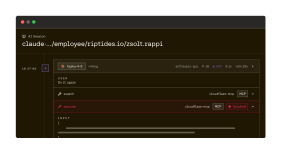
Know who did what, and why.
Every move an agent makes lands as one clear record — which agent, on whose behalf, and exactly what it touched. So when something breaks, the answer is a single query, not a multi-day hunt across five log systems.
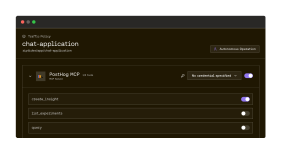
Decide what's allowed, what's not.
Each agent reaches only what you've allowed, and never holds a real credential to begin with. So a compromised agent has nowhere to go — and a leaked key has nothing worth stealing.
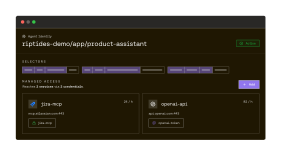
Every workload, one control plane.
Your old services and CI jobs have been hoarding long-lived keys since long before AI showed up. They get the same identity, rules, and just-in-time credentials as your agents — so it's one system to run, not a separate stack for the legacy stuff.
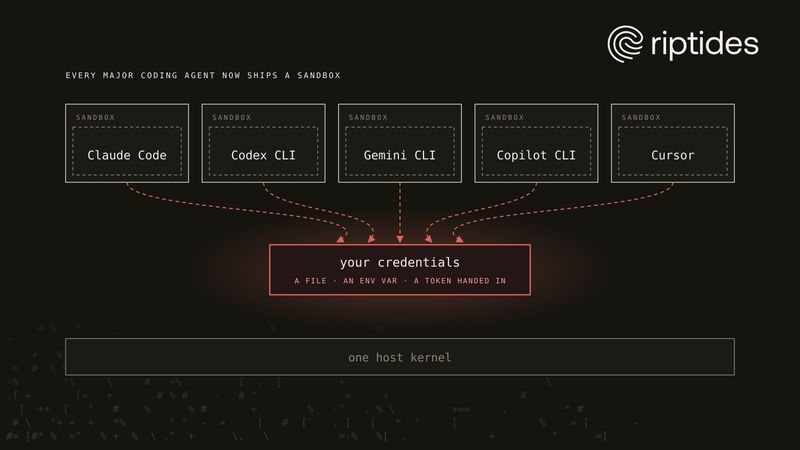
Everyone talks about identity.
Riptides enforces it at runtime.
Traditional tools stop short of runtime enforcement. Riptides closes the gap.
It turns identity into authorized, observable, and contained access.
How it works — self-serve in minutes.
No proxy to deploy. No SDK to integrate. Not even an application restart.
Sign up at riptides.io/get-started.
Drop it on a node or VM and connect it to your workspace.
$curl -fsSL https://docs.riptides.io/install.sh | sudo bash -s -- \$ --control-plane https://<acmecorp>.console.riptides.io
$riptides create -f agent-identity.yaml
Attribution starts flowing immediately — every connection, every tool call, every credential use.
$riptides create -f credential-binding.yaml
Secure the agents you're
already running.
Identity, access control, and a full audit trail for every agent and service — enforced on the host, with no code changes. Up and running in an afternoon.
Works With What You Already Run
No replacement required. Riptides sits alongside your existing secret store, cloud IAM, and observability stack.

Kubernetes
Workload identity built on Kubernetes metadata. Every pod, service, and job covered automatically.

SPIFFE
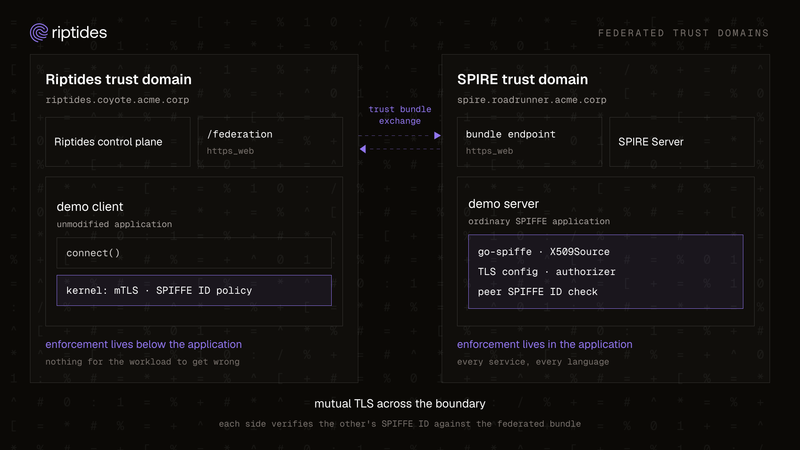
Standard SPIFFE SVIDs. Compatible with any system that speaks the SPIFFE spec.

OpenAI
Short-lived API keys injected at runtime. OpenAI agents never hold credentials between calls.

Grok
Short-lived API keys injected for xAI agents. No stored credentials, no rotation toil.

AWS
Federated trust to AWS IAM via Roles Anywhere. No static access keys in your workloads.

Google Cloud
Workload Identity Federation for GCP. Authenticate to Google Cloud using SPIFFE identity, no service account keys.

GitHub Actions
Every CI job gets a SPIFFE identity from its OIDC token. Secretless credential injection, no secrets pasted into your workflows.
From the Blog
Deep dives on kernel-level workload identity, secretless credentials, and AI agent security.

Frequently Asked Questions
Who is Riptides for?
Security and platform teams who know their workload credentials are a problem but haven't had a way to fix it without a large engineering project. If your team maintains rotation runbooks, can't attribute an alert to a specific service, or is deploying AI agents with no identity controls, Riptides is built for your situation.
How long does deployment take?
On Kubernetes, the kernel module deploys as a DaemonSet. On a VM or bare-metal host, it installs as a package. Either way, most teams are up and observing within an hour. It starts in permissive mode, so you see what it would enforce before you turn enforcement on. There is no big-bang cutover and no service downtime.
Will this break anything we already have running?
No. Riptides starts in permissive mode — it observes and logs without blocking anything. You see every connection and policy decision before enforcement is active. Move to enforce mode one service at a time at your own pace. If you remove the kernel module, workloads continue running without enforcement.
Do I need to change any application code?
No. Riptides operates at the Linux kernel, below the application layer. It covers every workload on the node automatically. No SDK to import, no annotation to add, no framework integration required. Your existing code runs without modification.
Does Riptides cover traditional workloads too, or just AI agents?
Both, from one control plane. The runtime identity, egress enforcement, and just-in-time credentials that govern AI agents apply unchanged to classic services and CI/CD pipelines. The static-credential problem predates AI, and the same kernel-level engine solves it — agents and traditional workloads governed from a single place.
How is Riptides different from a service mesh or AI gateway?
Service meshes and AI gateways operate at the application or network layer. They require sidecars, proxy configuration, or routing changes, and a compromised workload can route around them. Riptides enforces security at the kernel. No sidecars, no proxies, no code changes. Workloads cannot bypass, disable, or route around it.
Which agent frameworks and languages does Riptides work with?
All of them. Riptides operates at the kernel level, below the application layer, so it works with LangChain, CrewAI, AutoGen, OpenAI Agents SDK, MCP-based agents, and any custom agent or service that makes network calls. Any language, any framework, no integration required.
Does Riptides work with our existing secret store?
Yes. Riptides does not replace your secret store. It controls which workload gets which credential at runtime, so your workloads stop holding credentials themselves. It works alongside HashiCorp Vault, AWS Secrets Manager, Kubernetes Secrets, GCP Secret Manager, and Azure Key Vault.
Does Riptides store our secrets or credentials?
That is up to you and your deployment model. You can configure Riptides to fetch credentials from your own secret store at request time, storing nothing itself. Or you can have Riptides manage credentials directly. If you run the self-hosted control plane, everything stays within your environment. If you use the SaaS control plane, credential and policy configuration is managed outside your environment by Riptides.