Agents Changed the Workload and SPIFFE Is Changing With It.
Every standard faces the same quiet test. The world it was written for keeps moving, and the standard either moves with it or slowly turns into a description of how things used to work. Protocols that stop evolving do not fail loudly. They just start describing a smaller and smaller slice of reality until people route around them.
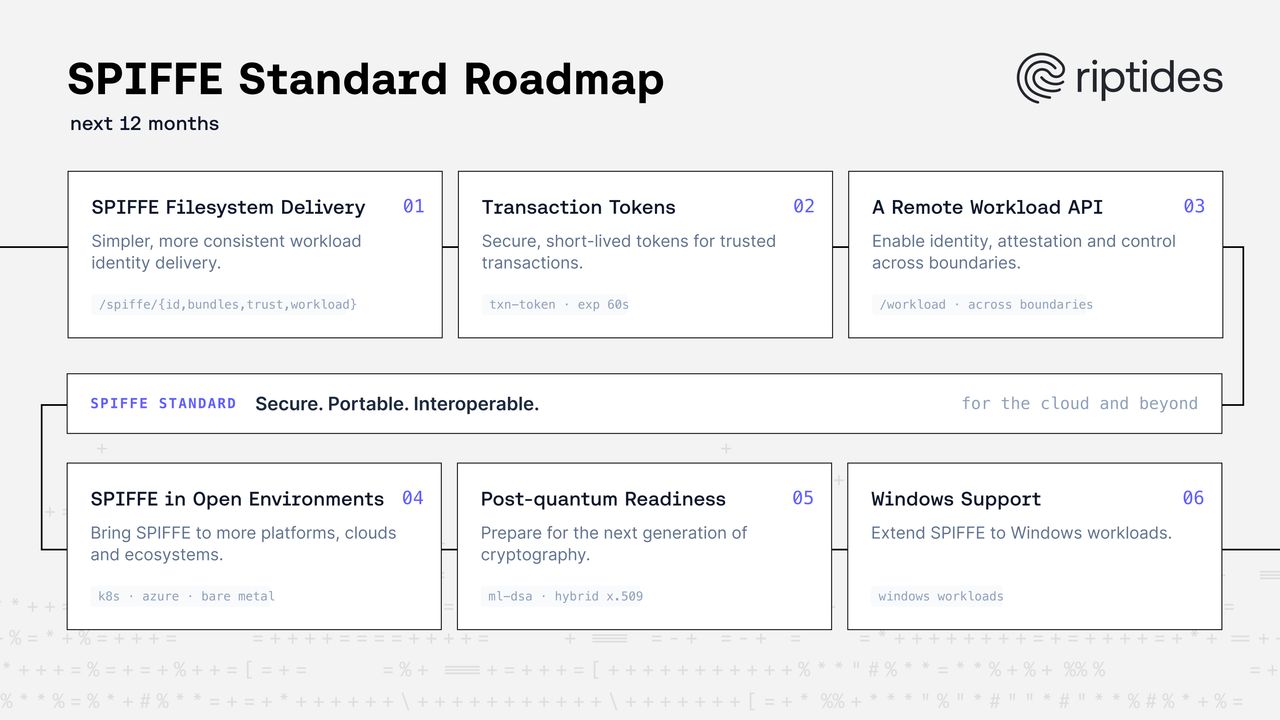
SPIFFE recently published its roadmap for the next twelve months, and it is a good example of a standard passing that test in the open. Riptides has written a lot about SPIFFE, because we build on it. Workload identity is the foundation we stand on, and SPIFFE is the substrate we chose to stand on it with. So when the people who steward the specification lay out where it is going, we read closely.
What stands out is not any single item on the list. It is the shape of the list as a whole. Read together, the roadmap is a response to how workloads actually run today, agents included. It is a standard listening to the ground beneath it.
From the bottom turtle to an identity layer
SPIFFE describes its own history as a climb. It started as a bootstrap credential, the bottom turtle, the one identity you could hand a workload before it had anything else. Over time it grew into something larger: an identity abstraction layer that spans clouds, clusters, and machines, so that a workload in one place can prove who it is to a workload in another without either side sharing a secret.
The roadmap is the next stretch of that same climb. And the interesting thing is where it is pointed. Almost every item answers a way the world has changed since the original model was drawn.
The workload no longer lives where you can reach it
The original SPIFFE model assumes you control the host the workload runs on. You put an agent on the node, and the node hands out identity locally. That assumption held for a long time. It is holding less well every year.
The roadmap is candid about this. It names the environments the current model leaves out: Kubernetes clusters with fully managed nodes like EKS Auto Mode and GKE Autopilot, where there is nowhere to place a node agent. Serverless platforms like Lambda, Cloud Run, and Azure Functions. CI systems like GitHub Actions. Managed AI-agent platforms. In all of them the workload is real and needs an identity, but the place you would normally put the machinery is not yours to touch.
A remote Workload API, standardized filesystem delivery, and upstreamed Windows support are all answers to the same question: how does SPIFFE reach a workload you cannot install anything next to. That is not a small feature. It is the “For Everyone” in Secure Production Identity Framework For Everyone being taken seriously. A standard that only worked where you owned the host would quietly be a standard for a shrinking set of deployments. Admitting that edge, and moving to close it, is what a healthy specification looks like.
The caller is no longer deterministic
For most of the history of workload identity, the question was simply who is calling. A service had a fairly predictable set of things it talked to, and identity told you which service was on the other end of the connection.
AI agents break that assumption in a specific way. An agent decides at runtime what to do, based on model output, so the same identity can take a different path through your infrastructure on every run. The roadmap names non-deterministic workloads directly and treats them as a first-class part of the environment SPIFFE now has to serve. That matters more than it might look. A standard that pretended agents did not exist would be describing 2019. Naming them, and asking what identity has to account for when the caller is autonomous, is the standard staying current with the systems people are actually shipping.
The boundary is no longer one organization
Federation has been part of SPIFFE for a while, so workloads in different trust domains can validate each other’s identities. But discovery has been manual. A peer has to learn out of band where your bundle lives, then configure the URL, the profile, and the trust domain name correctly, by hand, before anything works.
That is fine when two teams sit down and exchange details once. It does not scale to a world where workloads, and increasingly agents, act across trust boundaries with parties they have never met. The roadmap wants to bring trust domain discovery into the identifier itself, borrowing the .well-known pattern that OAuth and OpenID Connect already use, and that MCP is now leaning on. This is the internet’s own convention for “here is how you find out how to trust me” arriving in workload identity. It is the right borrow, and it points SPIFFE at open environments rather than only closed ones.
The threat model is moving underneath all of it
Underneath every one of these shifts, the cryptography has a horizon. The roadmap has started admitting post-quantum algorithms to the SVID specifications now, before any migration is urgent, so implementations are ready ahead of need rather than scrambling behind it.
There is nothing flashy about tending your cryptographic foundation early. It is exactly the kind of unglamorous, years-ahead thinking you want from the standard your identity rests on.
Why we read this as good news
Riptides builds kernel-level workload identity for precisely these conditions: workloads scattered across clouds and bare metal, agents that decide what to do at runtime, identity that has to hold across environments that do not trust each other by default. We did not bet on SPIFFE because it was finished. We bet on it because a shared identity substrate is the right foundation, and because the people building it are building it in the open.
A roadmap that widens that substrate to more environments, admits more kinds of workload, and extends the cryptographic horizon does not compete with that bet. It strengthens it. It is worth being honest that not every item here ships tomorrow. Some are proposals and open pull requests, and the community is still shaping them. That is the point. The direction is what matters, and the direction is toward the world modern infrastructure already lives in.
Riptides will keep building on SPIFFE.
How exposed are your workloads?
Run the NHI Security Audit Checklist, 8 questions to map your credential exposure, attribution gaps, and lateral movement surface across your own environment. Takes about 15 minutes.
Run the ChecklistFollow us on LinkedIn and X for more updates.