The Observability Trap
Your security team has great visibility. You see network flows. You monitor connections. Your eBPF-based tools flag suspicious activity in real time.
But visibility without enforcement is a spectator sport. When an attacker compromises a workload, the sequence is predictable: they scan the network, discover internal services, and authenticate using ambient credentials or stolen tokens. Your monitoring shows every step — but it doesn’t stop it.
This is the fundamental challenge enterprises face today. Tools that observe threats are table stakes. What separates contained incidents from breaches is whether you can enforce trust at the point of connection.
The Hidden Risk: Credentials in Motion
Most enterprise workloads authenticate using one of three mechanisms:
- Embedded credentials: API keys, database passwords stored in config or environment
- Short-lived tokens: OAuth tokens, JWT tokens from cloud providers
- Certificate-based identity: X.509 certificates managed by a central CA
Observability tools are designed to see that this is happening. They’re not designed to prevent unauthorized access when attackers get those credentials.
And they do. Regularly.
In a 2024 security incident, attackers didn’t exploit a software vulnerability. They found a staging database password in a CircleCI environment variable. Detection took weeks. The damage was extensive. No amount of network telemetry would have stopped it — the credentials were legitimate, even if the user holding them wasn’t.
This is where kernel-level enforcement changes the game.
From Visibility to Control
When identity is enforced at the kernel level, the attack chain breaks at a different point.
An attacker can still achieve code execution inside a workload. But that process — the attacker’s shell, their injected binary — has no identity of its own. It cannot authenticate to internal services, databases, or APIs, even if it finds the credentials. The kernel authenticates based on process identity, not the tokens or keys a process happens to possess.
This transforms the risk profile. RCE becomes a localized incident, not a cascading breach.
What This Means Operationally
Reduced dwell time: Threats are contained before lateral movement occurs. Your MTTR (mean time to recover) collapses because the blast radius is inherently limited.
Lower credential risk: Short-lived, process-bound identities replace long-lived secrets. Even if an attacker finds a credential, it’s useless outside the process that generated it.
Compliance acceleration: Zero trust security models now have a native enforcement layer. SOC 2, FedRAMP, and other compliance frameworks increasingly require cryptographic identity and mutual authentication — kernel-level enforcement delivers this natively.
Reduced security operations burden: Fewer false positives from visibility-only tools. Fewer incident response escalations. Fewer lateral movement attempts to investigate.
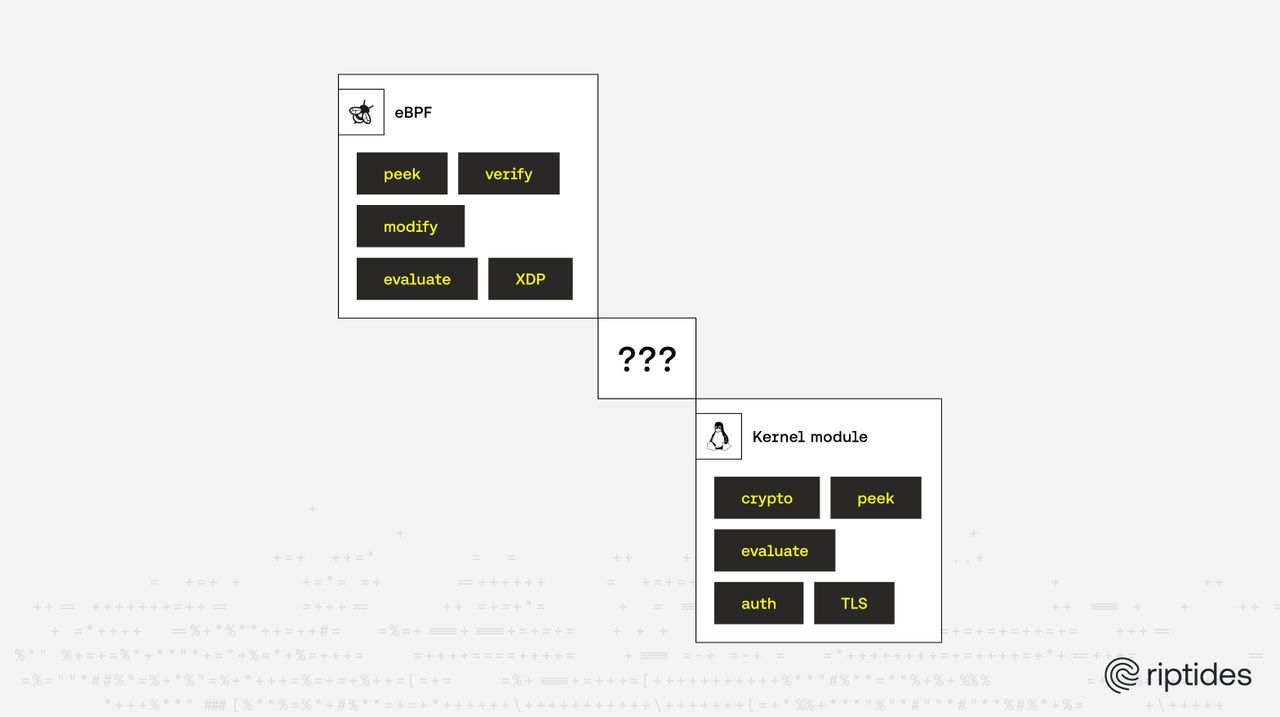
Why eBPF Alone Falls Short
eBPF is purpose-built for observability. It excels at:
- Tracing network flows in real time
- Detecting anomalous behavior patterns
- Logging system calls and context switches
- Filtering and sampling high-volume events
But eBPF runs in a sandbox by design. It cannot:
- Generate and manage cryptographic keys
- Perform TLS handshakes
- Inject or replace authentication headers transparently
- Enforce filesystem-level access control with process binding
- Create and manage scoped authentication paths
When you need to prevent an unauthorized process from connecting to a database, observability is insufficient. You need enforcement. And enforcement requires kernel integration.
The Enterprise Decision
Organizations typically face this decision after an incident. A workload gets compromised. Attackers move laterally. The post-mortem shows that all the suspicious activity was visible in logs — it just wasn’t blocked.
The question then becomes: how do we change this architecture so the next incident is contained before it becomes a breach?
Kernel-level identity solves this. Riptides brings that enforcement to any Linux environment without requiring code changes. Your applications keep working exactly as they do today. But internally, every connection is authenticated, every service proves its identity before communicating, and any process without legitimate identity simply cannot reach protected resources.
It’s the difference between watching an attack happen and stopping it from succeeding.
What Comes Next
If your organization is serious about zero trust, you’re already investing in workload identity. The question is whether that identity is enforced or merely declared. Observability and enforcement both matter — but enforcement is what stops breaches.
The economics are straightforward: the cost of a contained incident is your response time. The cost of a cascading breach is your customer data, regulatory fines, and reputation. Kernel-level enforcement shifts the outcome dramatically in your favor.
Interested in how kernel-level identity enforcement works in practice? Reach out for a demo to see Riptides in action, or read our technical deep dive on how we implement transparent kernel-based identity.
How exposed are your workloads?
Run the NHI Security Audit Checklist, 8 questions to map your credential exposure, attribution gaps, and lateral movement surface across your own environment. Takes about 15 minutes.
Run the ChecklistFollow us on LinkedIn and X for more updates.